
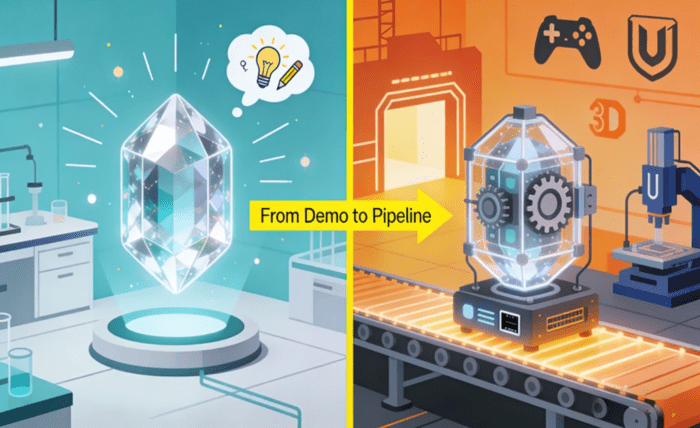
Remember when judging a 3D AI was simple? You’d type a prompt, wait a few seconds, and marvel at a shiny, photorealistic model spinning in your browser. That was the demo era. Pioneers like Tripo deserve huge credit for this. They showed the world the raw magic of turning text into 3D, proving that visualizing an idea could be as fast as a Google search.
But magic has to ship. When the first wave of excited developers and studios actually tried to use these AI models in real projects, they hit a wall. A stunning render in a browser is not a game-ready asset. That beautiful dragon model? It’s probably a topological nightmare, with messy UVs and no rigging. Getting it into your game engine or animation pipeline meant hours, sometimes days, of manual cleanup by a technical artist.
This is where the war changed direction. The fight isn’t about who makes the prettiest screenshot anymore. It’s about who survives the messy, pragmatic grind of a production pipeline. Tools like Neural4D aren’t just competing on quality; they’re reframing the entire contest around a new question: Does your AI understand what happens after generation?
From “Generate” to “Manufacture”: A New Definition of Useful
Tripo nailed the “zero to one” problem. It’s a phenomenal tool for conceptualizing and rapid prototyping. Its API lets developers bake that quick-turnaround capability into their own apps. For a solo designer sketching ideas or a marketer needing a quick 3D mockup, it’s powerful.
But for industries that run on digital assets, generating a static mesh is just step one. You’re left with a rough draft that needs extensive, expensive finishing work.
Neural4D is engineered to eliminate that finishing work from the start. Listen to what they emphasize: not just fidelity, but “pre-rigged, articulated skeletons” so animators don’t have to start from scratch. Not just textures, but “natively co-grown geometry and texture” to stop seams and misalignments before they happen. They talk about topology optimized for manufacturing and assets built for real-time engines.
Even their aggressive API pricing—reportedly a fraction of the cost of others—isn’t just a sales tactic. It’s a signal. It says they’ve built an efficient system meant to be called constantly, to become a standard utility on the digital factory floor. Chatgpt Plus Free Trial
Think of it this way: Tripo gives you a perfect block of marble. Neural4D aims to deliver a finished sculpture, already on its stand and ready for the gallery. Both provide the core material, but only one’s definition of “useful” includes the entire chain from design to deployment.
The Great Split: Serving Inspiration vs. Serving Integration
This difference reveals two diverging paths for the industry.
- Tripo’s path serves the spark of inspiration. It’s a digital sketchbook for concepts. Its superpower is speed and accessibility, perfect for the initial “what if?” phase of any project.
- Neural4D’s path is built for the grind of production. It’s a supplier for game dev, animation studios, and digital fabrication. Its value isn’t in the speed of the first idea, but in the total time saved from that first idea to a shippable, editable, animatable final product.
This isn’t about better or worse. It’s about different missions for different users. A filmmaker brainstorming creature designs needs Tripo’s instant magic. A game studio populating an open world with hundreds of unique, animatable NPCs needs Neural4D’s production-ready rigor.
The Bottom Line: An Industry Defining Its Layers
The Tripo vs. Neural4D comparison is bigger than two products. It’s the sign of a maturing industry starting to stratify.
We now have a Concept Layer, where tools prioritize creative ignition and instant gratification. Tripo champions this space brilliantly. And we have an emerging Production Layer, where tools must speak the language of pipelines, engines, and manufacturing constraints. This is where Neural4D is planting its flag.
The war hasn’t ended. It’s just relocated. The lab races for higher fidelity will continue, pushing the boundaries of what’s possible. But the battle that will determine the commercial size and impact of 3D AI is being fought on the production line. Here, victory doesn’t go to whoever makes the most beautiful demo. It goes to whoever makes the technology that quietly, reliably, and affordably disappears into the workflow—without causing another problem to solve.
True technological maturity isn’t about being amazing. It’s about being invisible.