
An HVAC system that runs for hours without reaching the set temperature creates a frustrating kind of uncertainty. The equipment is clearly operating, air is moving, and the thermostat is calling, yet the house still feels warmer or colder than it should. Many homeowners assume the unit is simply old or undersized, but constant runtime often indicates a deeper performance issue. Contractors approach this issue by looking past the obvious symptom and tracing what is limiting output. The goal is not just to make the system run. It is to understand why it cannot satisfy demand within a normal, controlled cycle.
Where Contractors Start First
- Airflow Problems Often Lead The Search
One of the first things an HVAC contractor checks is airflow, because a system cannot condition a home effectively if the air is not moving correctly through the equipment and ductwork. A clogged filter, a blocked return, a dirty evaporator coil, weak blower performance, or a crushed duct section can all reduce the amount of conditioned air reaching occupied rooms. When airflow drops, the system may still operate continuously, but it will struggle to remove heat or deliver warm air at the rate the home needs. Contractors usually inspect the return and supply sides together because a problem on either end can create long runtimes and uneven comfort. They also pay attention to whether certain rooms are starved for air while others seem closer to target, since that pattern often reveals a distribution issue rather than a full equipment failure. Teams familiar with Tuck & Howell Plumbing, Heating & Air, and similar high-demand environments know that airflow restrictions become even more obvious during extreme weather, when the system has no margin to absorb performance loss. In many cases, the constant runtime is not the root problem at all. It is the system’s response to air-delivery conditions that keeps it from doing its job efficiently.
- Refrigerant And Heat Transfer Get Tested
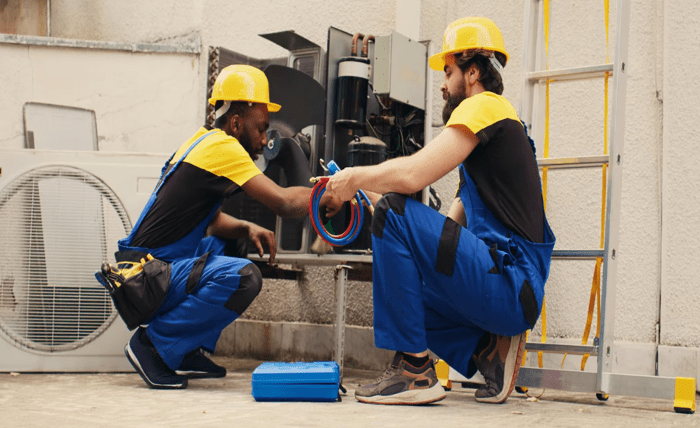
If airflow appears reasonably stable, contractors usually turn to the refrigeration side of the system during cooling calls or the heat-delivery side during heating calls to see whether the equipment is transferring energy as it should. In cooling mode, this often means checking refrigerant charge, coil condition, temperature split, and whether the outdoor unit is rejecting heat properly. A system that is low on refrigerant, operating with a restricted metering device, or dealing with a dirty condenser coil may run continuously because it is producing far less cooling than the homeowner expects. The air may feel somewhat cool at the vent, but the total capacity delivered to the house may still be insufficient to keep up. Contractors do not simply assume the unit needs more refrigerant or that the compressor is failing. They measure pressures, inspect coil conditions, and compare system behavior against expected operating ranges. In heating mode, they may check burner operation, temperature rise, airflow across the heat exchanger, or heat pump performance if the home uses electric heating. The central question remains the same in either season: is the equipment actually producing enough usable heating or cooling, or is it running constantly while underperforming because one part of the process is breaking down?
- Duct Leakage And Layout Change Results
A system can operate correctly at the equipment and still fail inside the home if the duct system is losing conditioned air or distributing it badly. That is why contractors look beyond the indoor and outdoor units when runtime becomes excessive. Hidden duct leakage in attics, crawlspaces, wall cavities, or garage ceiling runs can let a large portion of conditioned air escape before it ever reaches the rooms it was meant to serve. Return leaks can be just as damaging because they may pull in hot attic air, dusty crawlspace air, or other unconditioned air, increasing the load on the system. Contractors also evaluate duct layout because poor branch design, undersized trunk ducts, or weak return placement can make one side of the home comfortable while the rest lags. In these situations, the thermostat may never see balanced conditions long enough to satisfy the cycle. This is especially common in older homes, additions, and remodels where the original duct system was never redesigned to match the current layout. A careful contractor knows that replacing equipment without checking for leaks and distribution issues can leave the homeowner with the same complaint, only attached to a newer unit. Long runtime often indicates a house is receiving less conditioned air than the equipment is trying to provide.
Constant Runtime Needs A Precise Diagnosis
When an HVAC system runs constantly without keeping up, contractors are not just looking for one broken part. They are trying to determine whether airflow is restricted, refrigerant or heat transfer is weak, ductwork is leaking, or the house itself is driving loads beyond what the system can comfortably manage. That matters because long runtime is a symptom with several possible causes, and the wrong assumption can lead to wasted money and repeated frustration. A solid diagnosis turns a vague complaint into a practical repair path, which is exactly what homeowners need when the equipment never seems to stop.