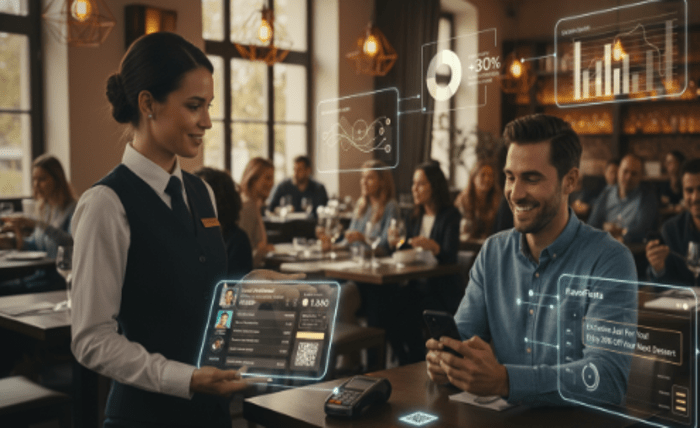
Great food might bring customers in once, but experience is what brings them back.
Restaurants are no longer just competing on taste or pricing; they’re competing on how well they understand and engage their guests.
This is where restaurant CRM becomes a game-changer. Instead of relying on guesswork or generic promotions, modern restaurants use data to create meaningful, personalized interactions.
At the same time, traditional, one-size-fits-all restaurant loyalty programs are losing their impact.
Now customers expect more than points and punch cards. They expect relevance. By combining restaurant CRM with intelligent loyalty strategies, restaurants can turn scattered guest data into actionable insights.
Before we delve deeper, let’s understand:
What Is a Restaurant CRM?
A restaurant CRM is a software that manages your guests’ and diners’ data to create personalized customer experiences. While sometimes it is used interchangeably with customer databases, they differ vastly.
Here are some differences they pose:
Difference between restaurant CRM and basic customer database.
| Feature | Basic Customer Database | Restaurant CRM |
| Stores customer data | ✔ | ✔ |
| Tracks customer interactions | ✘ | ✔ |
| Sales pipeline management | ✘ | ✔ |
| Task & follow-up automation | ✘ | ✔ |
| Reporting & analytics | ✘ | ✔ |
| Integration with other tools | ✘ | ✔ |
Now that we know how they differ, let’s look at the types of customer data restaurant CRMs track.
Types of customer data a CRM tracks:
1. Visit frequency
Track how often a diner visits your restaurant, website, or app.
2. Order history
View past orders, order frequency, average spend, dining method (dine-in, takeaway, or delivery), and peak ordering times.
3. Favorite items
Personalize offers with customers’ most frequently ordered dishes, preferred cuisines, and repeat choices.
4. Average spend
Calculate how a customer typically spends per visit to help segment high-value customers.
5. Feedback/reviews
Capture customer ratings, reviews, and comments from surveys, apps, or platforms.
6. Birthday/anniversary data
Store important personal dates to send personalized wishes, special discounts, or exclusive offers, helping build stronger connections.
Why Traditional Loyalty Programs Are No Longer Enough
The common issues with traditional loyalty programs using customer data in silo are:
Low redemption rates
There is a low redemption rate due to unappealing rewards and a one-size-fits-all approach.
Generic rewards
With flat discounts, customers don’t feel valued; they feel they are getting a routine deal they could get anywhere else.
No behavioral targeting
Without analyzing purchase patterns, you may fail to upsell or cross-sell.
Poor integration with POS
In the absence of restaurant POS integration, customer transactions aren’t tracked in real time, leading to a loss of purchase history.
How Restaurant CRM Powers Smarter Restaurant Loyalty Programs
Now that we know why traditional loyalty programs are lacking, let’s dive into how restaurant CRM drives smart loyalty programs. It does so by
Personalized offers based on order history
Modern restaurant CRM transforms loyalty programs by turning raw order data into personalized experiences.
Automated campaigns for inactive customers
Automatically win back customers who’ve stopped visiting. Identify inactivity patterns and trigger targeted campaigns to re-engage customers.
Birthday/anniversary rewards
By capturing key dates, the CRM can automatically trigger timely offers such as “free dessert or drink on birthday.”
VIP segmentation for high-value guests
By analyzing visit frequency, average spend, and order patterns, automatically group high-value diners into VIP tiers.
Win-back campaigns for churned diners
CRM uses data to identify which customers have stopped visiting and trigger targeted campaigns to bring them back.
Key Benefits of Combining CRM and Loyalty for Restaurants
Here are some pivotal benefits of a restaurant CRM and loyalty program working in unison:
Increased Repeat Visits
Customers get offers on what they order most, and also receive promotions during long absences.
Higher Average Ticket Size
CRM increases ticket size based on past orders (e.g., “Add your favorite dessert at 20% off”).
Better Customer Retention
CRM improves retention via personalized engagement, keeping customers interested, and loyalty rewards incentivize repeat visits.
Improved Marketing ROI
Instead of sending the same offer to your entire customer base, a CRM uses data to segment diners and trigger personalized campaigns.
Features to Look for in a Restaurant CRM and Loyalty Platform
As we are acquainted with the benefits of restaurant CRM and loyalty platforms, let’s understand their features:
POS integration
A restaurant CRM must be built into a native POS to synchronize data effectively and record every transaction in a customer profile.
Automated segmentation
Segregate customers on the basis of behavior as VIPs, frequent diners, and inactive users.
Multi-channel messaging (email/SMS/WhatsApp)
Reach out to customers via email, SMS, or WhatsApp on their preferred platform.
Campaign automation
Give birthday or anniversary discounts or offers. Roll out win-back campaigns for inactive diners.
Guest analytics/dashboard
You can track revenue from loyalty members and monitor campaign performance and ROI.
Mobile-friendly loyalty enrollment
Engage customers with QR-based sign-ups at the table and a mobile-first loyalty experience.
Why Integrated Platforms Outperform Standalone Tools
Thus come integrated platforms; they dominate the market because there are
Problems with disconnected CRM and loyalty systems
When CRM systems and loyalty systems run separately, it creates gaps that directly impact CX.
Benefits of unified platforms:
Single customer profile
All customer data, i.e., orders, preferences, rewards, and visit history, lives in one place with better personalization and targeting.
Real-time campaign triggers
Send offers right after a visit and trigger rewards at checkout.
Easier reporting
With all data in one system, reporting becomes clear and actionable.
Better staff adoption
Staff don’t need to switch between tools, and billing and reward redemption are faster.
How NOVA Helps Restaurants Build Stronger Guest Relationships
NOVA is an all-in-one restaurant management platform that combines POS, CRM, loyalty, and marketing automation. It creates a single, real-time view of every customer by combining POS data, order history, and loyalty activity.
It enables restaurants to
Track guest behavior in real time
Identify what customers love and when they visit to detect drop-offs or inactivity instantly.
Launch targeted campaigns
NOVA empowers you to move from mass marketing to precision targeting.
Build personalized loyalty experiences
With its in-built CRM, NOVA launches personalized campaigns, building brand loyalty.
Increase repeat revenue
Since the customers visit more often, it increases repeat revenue and enhances the overall bottom line.
If you want to have a seamless restaurant CRM and loyalty program experience, book a FREE DEMO with NOVA today.
Leverage Data into Repeated Revenue
Restaurant growth comes from retention, not just acquisition. Operators who combine CRM and loyalty gain a competitive advantage. Restaurants that move beyond generic marketing and adopt data-driven strategies gain a clear competitive edge, higher repeat visits, better customer relationships, and stronger revenue over time.
If your current systems are disconnected or underutilized, now is the time to rethink your approach. Evaluate your tech stack, identify the gaps, and invest in a unified platform that turns guest data into action.
FAQs
- How do restaurant loyalty programs improve retention?
Restaurant loyalty programs improve retention by transforming occasional diners into loyal customers.
2. Can a CRM integrate with restaurant POS systems?
Yes, a CRM can integrate with a restaurant POS system to drive brand loyalty and enable a personalized dining experience.