
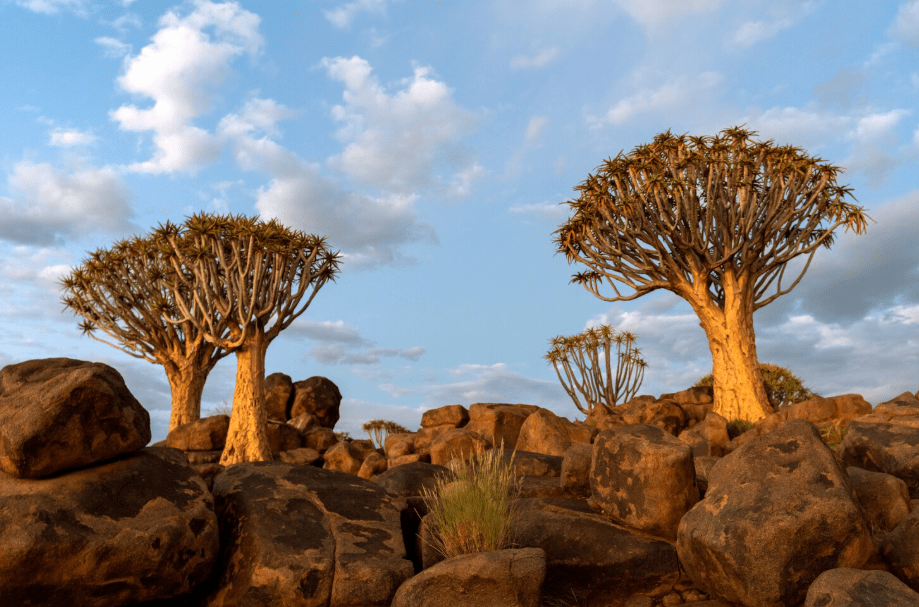
There’s a reason the Dragon Blood Tree has become the single image most associated with Socotra. An umbrella-shaped canopy balanced on a thick, branching trunk, growing directly out of bare rock, with a deep red sap running underneath its bark, it doesn’t look like it belongs in this era of the planet, let alone this one. That’s not far from the truth.
What makes it look the way it does
The Dragon Blood Tree (Dracaena cinnabari) is endemic to Socotra, meaning it grows nowhere else on Earth. Its inverted-umbrella shape isn’t decorative, it’s an adaptation. The tightly packed canopy minimises water loss and casts a dense pool of shade beneath the tree, which helps the seedlings below survive in Socotra’s punishingly arid, wind-scoured environment. Individual trees can live for several centuries, and some of the oldest specimens in Firmhin Forest, the island’s largest remaining stand of them, are believed to be hundreds of years old.
The tree’s namesake feature is its resin: when the bark is cut, it seeps a thick, blood-red sap that gives the species its common name. That sap has a long history well beyond Socotra. Used for centuries in dyes, varnishes, and traditional medicine across the Arab world and beyond, and, according to island legend, the direct result of an ancient dragon dying at that exact spot. Whether or not you buy the legend, it’s easy to see how a tree bleeding red resin, on an island this isolated, became the stuff of myth.
An island frozen in time
Socotra split from the African-Arabian mainland an estimated 6 to 7 million years ago, and the Dragon Blood Tree is one of roughly 700 plant species that evolved in that isolation, around a third of which exist nowhere else on the planet. Botanists sometimes describe Socotra’s flora as a living relic of what much of the region looked like millions of years before the climate shifted and turned most of it to desert. Standing in Firmhin Forest at sunrise, surrounded by hundreds of these trees silhouetted against the light, is the closest most travellers will ever get to walking through a different geological period.
Why the forest is under pressure
For a species that’s survived for millions of years, the Dragon Blood Tree is now facing a genuinely uncertain future. Studies on the island have found that young trees are struggling to establish themselves, partly due to overgrazing by goats and partly due to a shifting climate that’s altering the fog and rainfall patterns the trees depend on. UNESCO listed Socotra as a World Heritage Site in 2008 specifically to help protect this kind of biodiversity, and conservation efforts on the island are ongoing, but the forest remains fragile.
That fragility is part of why how you visit matters. Tourism has grown steadily on Socotra over the past decade, and popular sites — Firmhin Forest chief among them — can get crowded at peak times, which isn’t good for the ecosystem or the experience. It’s also why local guides matter more here than almost anywhere else: they know which sections of the forest to walk through at which hour, how to time a visit around other groups, and which areas are sensitive enough to leave undisturbed.
Seeing them the right way
The best way to experience the Dragon Blood Trees isn’t a quick roadside photo stop, it’s arriving before sunrise, when the light is soft and the forest is empty, and staying long enough to actually take in the scale of it. That kind of timing depends entirely on local knowledge, which is exactly why operators actually based on Socotra tend to deliver a fundamentally different experience than ones running trips remotely.
Tour Socotra, run entirely by guides, drivers, and chefs who grew up on the island, has built relationships with local tribes that give them access to campsites near Firmhin Forest kept deliberately separate from other groups, meaning their guests get the sunrise walk through the trees without the crowds that have started to gather at more accessible viewpoints. It’s a small logistical detail that makes an outsized difference to the actual experience of standing among trees that have been there for centuries.
A forest worth protecting
The Dragon Blood Tree isn’t just Socotra’s most photographed feature, it’s a genuine botanical rarity, millions of years in the making, and increasingly fragile. Seeing it responsibly, with people who understand both the ecology and the timing, is the difference between a quick photo and an experience you’ll actually remember.